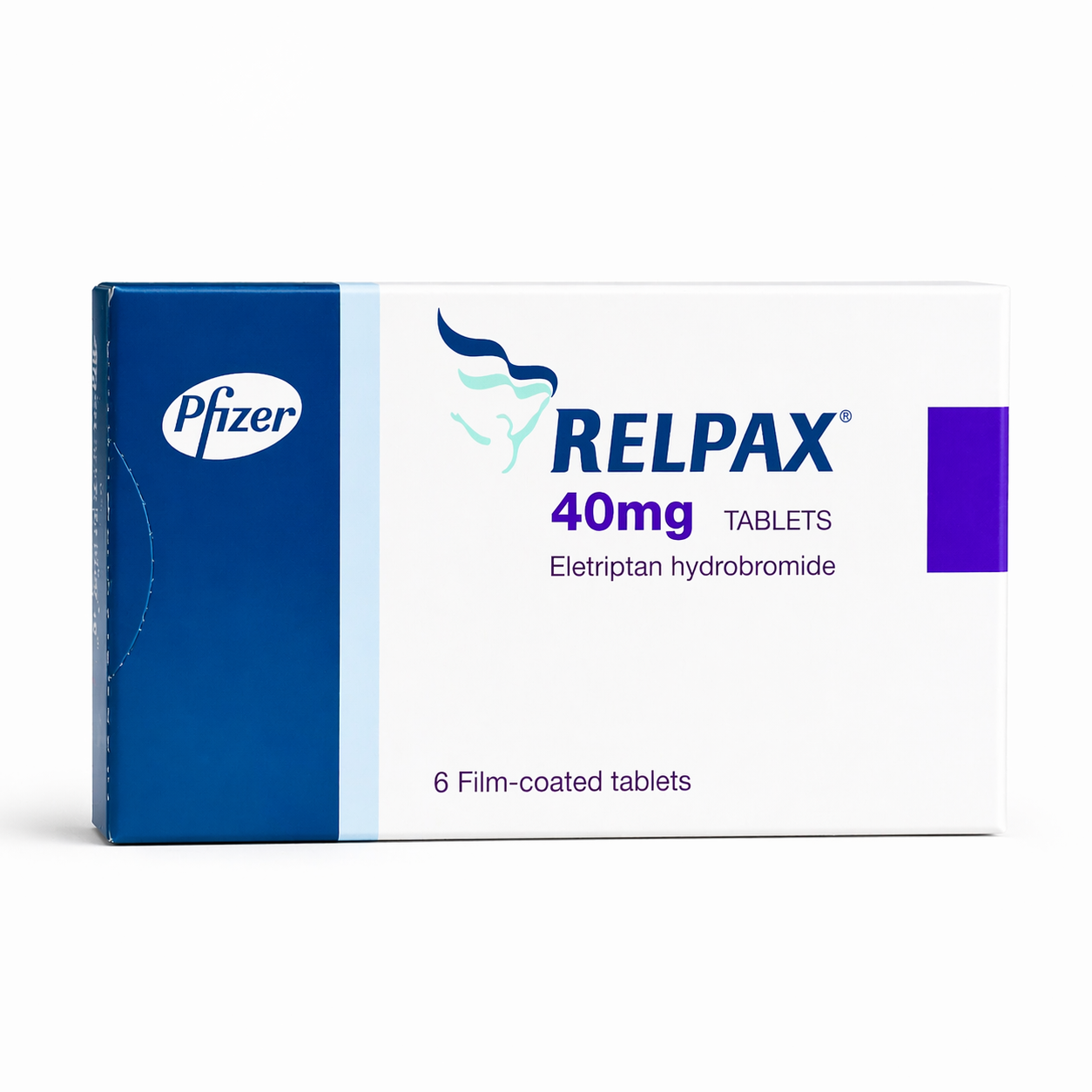
Relpax 40mg Film-coated Tablets
£15.99
Relpax is used to treat acute migraine attacks with or without aura in adults who have already been diagnosed with migraine, following a clinical assessment.
It contains eletriptan, which works by narrowing blood vessels in the head and reducing nerve activity that causes migraine symptoms. This helps relieve headache, nausea, and sensitivity to light or sound during a migraine attack. It cannot prevent future migraine attacks.
Please Note: You are also required to complete a form at checkout. In addition, a video consultation with our pharmacist may be required.
Payment does not guarantee approval or supply
All prescription medication (Online Clinic) requests are subject to an independent clinical assessment. The final decision, including the medication and dose prescribed, rests with the prescriber. If your request is declined and no medication is supplied, your payment will be refunded in full in accordance with our refund policy.
Categories: Age verification, General, Migraine, Online Clinic
Tags: ID Required, Private Rx
What Relpax 40mg is used for?
Relpax is used for the acute treatment of migraine attacks, with or without aura, in adults who have already been diagnosed with migraine. Migraines can cause severe headaches along with symptoms such as nausea, and sensitivity to light or sound. Relpax helps relieve these symptoms during an attack but does not prevent future migraines. It should not be used if you have not been diagnosed with migraine.
How Relpax 40mg works
Relpax contains the active substance eletriptan, which belongs to a group of medicines called serotonin (5-HT1) receptor agonists, often referred to as “triptans.”
During a migraine attack, blood vessels in the brain can widen, contributing to pain and other symptoms. Eletriptan works by narrowing these blood vessels and reducing the release of inflammatory substances and nerve signals involved in migraine.
This action helps relieve headache pain, nausea, and sensitivity to light or sound, allowing you to return to normal daily activities more comfortably.
| Quantity | 3 |
|---|
Always use this medicine exactly as your doctor or pharmacist has told you. Check with your doctor or pharmacist if you are not sure how to use this medicine.
The recommended dose in adults:
Take a single dose should be taken for a migraine attacks. Swallow each tablet whole with a drink of water. It is recommended that a dose is taken as early as possible after the onset of migraine headache.
Relpax, if taken during the aura phase, has not demonstrated to prevent migraine headaches and therefore, should only be taken during the headache phase of a migraine.
If symptoms recur after initial relief, a second dose may be taken in the next 24 hours, providing there is an interval of at least 2 hours between the 2 doses.
No more than 2 doses (80mg) to be taken in any 24 hour period.
If the first dose does not provide relief, a second dose must not be taken for the same attack, however can be taken for subsequent attacks. The use of paracetamol, aspirin or non-steroidal anti-inflammatory drugs may be appropriate.
If you find that a dose of one 40 mg tablet does not relieve your migraines, speak to your prescriber.
If you take more Relpax than you should
If you accidentally take too much Relpax, contact your doctor at once or go to the nearest hospital casualty department. Always take the labelled medicine package with you, whether there is any medicine left or not. Side effects from taking too much Relpax include high blood pressure and heart problems.
If you forget to take Relpax
If you forget to take a dose, take it as soon as you remember unless it is time for your next dose. Do not take a double dose to make up for a forgotten dose.
Like all medicines, this medicine can cause side effects, although not everybody gets them. Some of the side effects are temporary with continued treatment or disappeared when treatment is stopped.
Side Effects
Common
- Chest pain or tightness or pressure, Heart palpitations, Increased heart rate
- Dizziness, Sensation of spinning or whirling (Vertigo), Headache, Feeling sleepy, Reduced sense of touch or pain
- Sore throat, Throat tightness, Dry mouth
- Abdominal and stomach pain, Indigestion (upset stomach), Nausea (sensation of unease and discomfort in stomach or abdomen with an urge to vomit)
- Stiffness (Increased muscle tone), Muscle weakness, Back pain, Muscle pain
- Generally feeling weak, Feeling hot, Chills, Runny nose, Sweating, Tingling or abnormal sensation, Flushing, Pain
Uncommon
- Difficulty breathing, Yawning
- Swelling of the face or hands and feet, Inflammation or infection of the tongue, Skin rash, Itching
- Increased sense of touch or pain (Hyperaesthesia), Loss of co-ordination, Slow or reduced movement, Tremor, Slurred speech
- Not feeling one self (Depersonalisation), Depression, Thinking strangely, Feeling agitated, Feeling confused, Mood swings (Euphoria), Periods of unresponsiveness (Stupor), General feeling of discomfort, Illness or lack of well being (Malaise), Sleeplessness (Insomnia)
- Loss of appetite and weight loss (Anorexia), Taste disturbance, Thirst
- Degeneration of the joints (Arthrosis), Bone pain, Joint pain
- Increased need to pass water (urinate), Problems with urinating, Passing excessive quantity of urine, Diarrhoea
- Abnormal vision, Eye pain, Intolerance to light, Dry or watery eyes
- Ear pain, Ringing in the ears (Tinnitus)
- Poor circulation (Peripheral vascular disorder)
Rare
- Shock, Asthma, Hives (Urticaria), Skin disorder, Swollen tongue
- Throat or chest infection, Swollen lymph glands
- Slow heart rate
- Emotionally fragile (mood swings)
- Degeneration of joints (Arthritis), Muscle disorder, Twitching
- Constipation, Inflamed gullet, Belching
- Breast Pain, Heavy or prolonged menstrual periods
- Eye infection (Conjunctivitis)
- Changes to voice
Other side effects reported include, fainting, high blood pressure, inflammation of the large intestine, vomiting, brain and blood vessel-related accident, inadequate heart blood flow, heart attack, heart muscle/artery-related spasm.
Serious Side Effects
Tell your doctor immediately if you experience any of the following symptoms after taking this medicine.
- Sudden wheeziness, difficulty in breathing, swelling of eyelids, face or lips, rash or itching (especially affecting the whole body) as this may be a sign of a hypersensitivity reaction.
- Chest pain and tightness, which may be intense and involve the throat. These may be symptoms of problems of the blood circulation of the heart (Ischaemic heart disease).
- Signs and symptoms of serotonin syndrome which may include restlessness, hallucinations, loss of co-ordination, fast heart beat, increase body temperature, fast changes in blood pressure and overactive reflexes.
If you get any side effects, talk to your doctor, pharmacist or nurse. This includes any possible side effects not listed in this leaflet. You can also report side effects directly via the Yellow Card Scheme, website: www.mhra.gov.uk/yellowcard or search for MHRA Yellow Card in the Google Play or Apple App Store. By reporting side effects, you can help provide more information on the safety of this medicine.
Warning & Precautions
Do not take Relpax:
- If you are allergic (hypersensitive) to eletriptan, or any of the other ingredients of this medicine
- If you have severe liver or kidney disease
- If you have moderate to severe high blood pressure or untreated mild high blood pressure
- If you have ever had heart problems, (e.g. heart attack, angina, heart failure or significant abnormal heart rhythm (arrhythmia), temporary, sudden narrowing of one of the coronary arteries)
- If you have poor circulation (peripheral vascular disease).
- If you have ever had a stroke (even a mild one that lasted for only a few minutes or hours).
- If you have taken ergotamine or medicines like ergotamine (including methysergide) within 24 hours before or after taking Relpax.
If you are taking any other medicines that end in ‘triptan’ (for example sumatriptan, rizatriptan, naratriptan, zolmitriptan, almotriptan and frovatriptan).
Please consult your doctor and do not take Relpax, if these statements apply to you now orhave applied to you at any time in the past.
Talk to your doctor or pharmacist before taking Relpax if:
- you have diabetes
- you smoke or use nicotine replacement therapy
- you are male and over 40 years
- you are female and post-menopausal
- you or anybody in your family have coronary artery disease
- you have ever been told that you may have an increased risk of heart disease, discuss this with your doctor before using Relpax
Repeat use of migraine medicines
If you repeatedly use Relpax or any medicines for the treatment of migraine over several days or weeks, this can cause daily long-term headaches. Tell your doctor if you experience this as you might need to stop treatment for a while.
Age Restrictions
For adults over the age of 18 years – 65 years
Other Medicines and Conditions
Tell your doctor or pharmacist if you are taking, have recently taken or might take any other medicines.
Taking Relpax together with some medicines may cause serious side effects. Do not use Relpax if:
- you have taken ergotamine or medicines like ergotamine (including methysergide) within 24 hours before or after taking Relpax
- you are taking any other medicines that end in ‘triptan’ (for example sumatriptan, rizatriptan, naratriptan, zolmitriptan, almotriptan and frovatriptan)
Some medicines can affect the way Relpax works, or Relpax itself can reduce the effectiveness of other medicines taken at the same time. These include:
- Drugs used to treat fungal infections (e.g. ketoconazole and itraconazole).
- Drugs used to treat bacterial infections (e.g. erythromycin, clarithromycin and josamycin).
- Drugs used to treat AIDS and HIV (e.g. ritonavir, indinavir and nelfinavir).
- The herbal preparation St John’s wort (Hypericum perforatum) should not be taken at the same time as this medicine. If you already take St John’s wort, consult your doctor before stopping the St John’s wort preparation.
- Tell your doctor before starting treatment with eletriptan, if you are taking some medicines (commonly referred to as SSRIs – Selective serotonin re-uptake inhibitors or SNRIs – Serotonin norepinephrine re-uptake inhibitors), for depression and other mental disorders. These medicines may increase the risk of developing serotonin syndrome during combined use with certain migraine medications.
Driving and using machines
You may feel sleepy, dizzy or sick either due to the migraine itself or the use of these tablets. If ever occur, this may influence the ability to drive and to operate machinery. Caution is recommended if you engage in such activities.
Pregnancy and Breastfeeding
Not recommended for use in pregnancy and breastfeeding.
Patient Information Leaflet
https://www.medicines.org.uk/emc/files/pil.1265.pdf
Ingredients
- Active Ingredients: Eletriptan
- Other Ingredients: microcrystalline cellulose, lactose monohydrate, croscarmellose sodium, magnesium stearate, titanium dioxide (E171), hypromellose, glycerol triacetate and Sunset Yellow FCF Aluminium Lake (E110), Lactose, the dye Sunset Yellow Aluminium Lake (E 110), and Sodium.
Product Information
- Brand Name: Relpax
- Route of Administration: Oral
- Legal Classification: POM
- Strength: 40mg
- Dosage Form: Film-coated Tablet
Storage
- Keep this medicine out of the sight and reach of children.
- This medicinal product does not require any special storage conditions.
- Do not take this medicine after the expiry date which is stated on the carton or blister after “EXP”. The expiry date refers to the last day of that month.
- Do not throw away any medicines via wastewater or household waste. Ask your pharmacist how to throw away medicines you no longer use. These measures will help to protect the environment.
Advice and Helpful Links
https://www.nhs.uk/conditions/migraine/
https://patient.info/brain-nerves/headache-leaflet/medication-overuse-headache