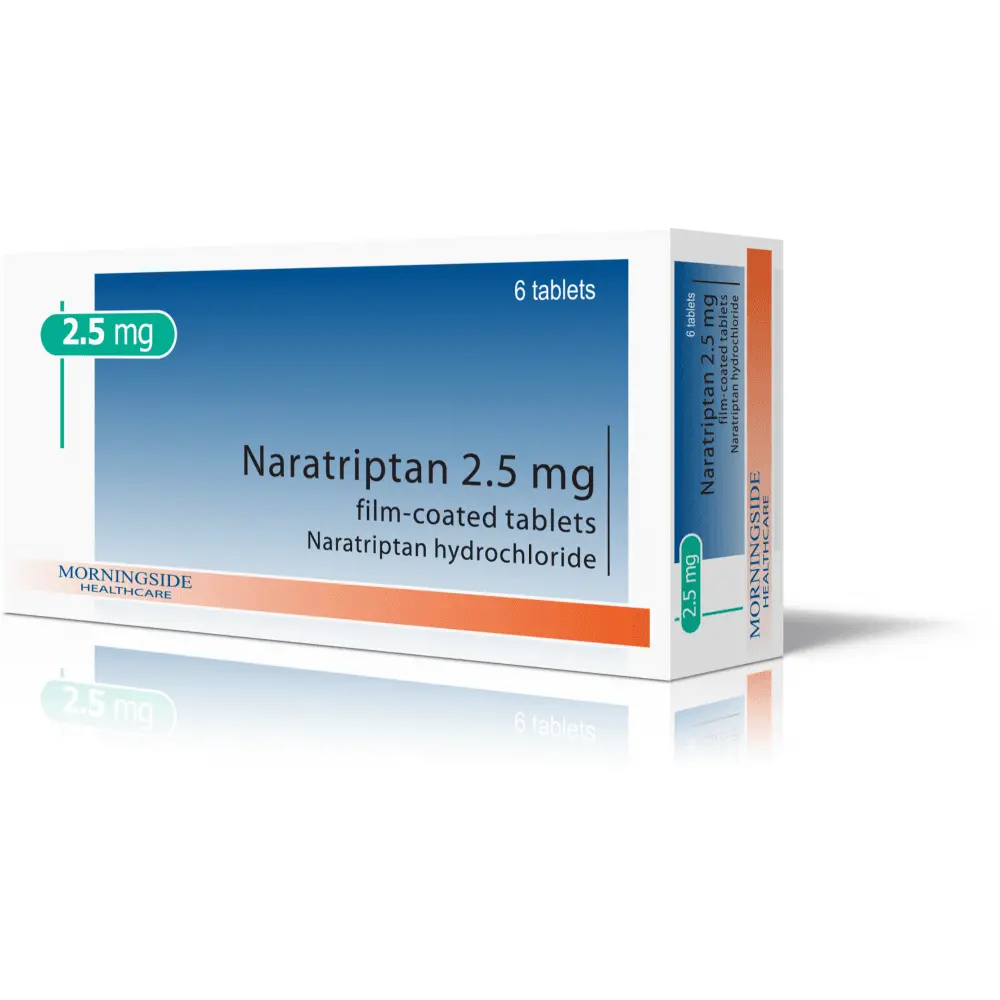
Naramig (Naratriptan) 2.5mg Migraine Relief Tablets (Pack size 6)
£9.99
Naramig is used to treat migraine attacks with or without aura in adults who have already been diagnosed with migraine, following a clinical assessment.
It contains naratriptan, which belongs to a group of medicines called selective serotonin (5-HT1) receptor agonists. Naratriptan works by narrowing blood vessels in the brain and reducing the inflammation associated with migraine attacks, helping to relieve headache, nausea, and sensitivity to light or sound during an attack.
Please Note: You are also required to complete a form at checkout. In addition, a video consultation with our pharmacist may be required.
Payment does not guarantee approval or supply
All prescription medication (Online Clinic) requests are subject to an independent clinical assessment. The final decision, including the medication and dose prescribed, rests with the prescriber. If your request is declined and no medication is supplied, your payment will be refunded in full in accordance with our refund policy.
Categories: Age verification, General, Migraine, Online Clinic
Tags: Private Rx
What is Naramig used for?
Naramig 2.5 mg Tablets are used to treat sudden migraine attacks, with or without aura, in adults who have already been diagnosed with migraine. Migraines can cause severe headaches, nausea or vomiting, and sensitivity to light or sound. Naramig helps relieve these symptoms during an attack but cannot prevent future migraines. It should not be used if you have not been diagnosed with migraine.
How Naramig works
Naramig contains naratriptan, which belongs to a group of medicines called selective serotonin (5-HT1) receptor agonists. Migraine symptoms may be caused by temporary widening of blood vessels and inflammation in the brain. Naratriptan works by narrowing blood vessels in the brain and reducing the inflammatory response associated with migraine attacks.
This helps relieve headache, nausea, vomiting, and sensitivity to light or sound, allowing you to carry on with your daily activities more comfortably.
Always use this medicine exactly as your doctor or pharmacist has told you. Check with your doctor or pharmacist if you are not sure how to use this medicine.
The recommended dose in adults:
One 2.5 mg tablet which should be taken as early as possible after the onset of the migraine attack.
The maximum daily dose is two (2.5mg) tablets within 24 hours. Medication should be swallowed with liquid (e.g. water) and can be taken with or without food. Naramig should only be used to treat an actual migraine attack and not to prevent migraine attacks or headaches.
If your migraine attack does not subside, do not take more than one tablet for the same attack.
If you experience a second migraine attack within 24 hours, a second 2.5mg tablet can be taken but you must leave at least four hours between your first and second tablet.
You should take Naramig as soon as possible after the onset of the migraine, although it is still effective if taken at a later stage.
If you take more Naramig than you should
If you accidentally take too many tablets, or if someone else or a child takes this medicine, talk to a doctor or pharmacist immediately.
If you forget to take Naramig
Try to take Naramig as you have been prescribed. Do not take a double dose to make up for a forgotten tablet.
Like all medicines, this medicine can cause side effects, although not everybody gets them. Some of the side effects are temporary with continued treatment or disappeared when treatment is stopped.
Side Effects
Common
- Feeling sick (nausea) or being sick (vomiting), although this may be due to the migraine itself
- Tiredness, drowsiness or sleepiness (somnolence), or generally feeling unwell
- Dizziness, tingling feelings or getting hot flushes
Uncommon
- Visual disturbances (although these may be due to the migraine attack itself)
- Slight increase in blood pressure which may occur up to 12 hours after taking Naramig
Very Rare
- Heart problems, including chest pains (angina) and heart attack
- Poor blood circulation to the arms and legs, causing pain and discomfort
Serious Side Effects
Tell your doctor straight away if you notice any of the following serious side effects – you may need urgent medical treatment:
- Heartbeat may go faster, slower or change rhythm
- Pain in the lower left side of the stomach and bloody diarrhoea
- Allergic reaction. The signs of allergy include rash; hives; itching; wheezing; swollen eyelids, face or lips; complete collapse
- Heaviness, pressure, tightness or pain in the chest, throat or other parts of the body. These effects may be intense but generally pass quickly.If these effects continue or become severe (especially the chest pain), get medical help urgently. In a very small number of people these symptoms can be caused by a heart attack
If you get any side effects, talk to your doctor, pharmacist or nurse. This includes any possible side effects not listed in this leaflet. You can also report side effects directly via the Yellow Card Scheme, website: www.mhra.gov.uk/yellowcard or search for MHRA Yellow Card in the Google Play or Apple App Store. By reporting side effects, you can help provide more information on the safety of this medicine.
Warning & Precautions
Do not take Naramig:
- If you are allergic to naratriptan, or any of the other ingredients of this medicine
- If you have a heart problem such as heart failure or chest pains (angina), or have already had a heart attack
- If you have circulation problems in your legs that cause cramp-like pains when you walk (peripheral vascular disease)
- If you have had a stroke or a mini-stroke (also called a transient ischaemic attack or TIA)
- If you have high blood pressure. You may be able to take Naramig if your high blood pressure is mild and is being treated.
- If you have kidney or liver disease
- With other migraine medicines, including those which contain ergotamine, or with similar medicines such as methysergide, or with other 5-HT1 receptor agonists, such as sumatriptan.
If any of these apply to you, speak to your doctor, and don’t take Naramig.
Talk to your doctor or pharmacist before taking Naramig.
If you have any extra risk factors:
- If you are a heavy smoker or are using nicotine replacement therapy, and especially
- If you are a man over 40, or if you are a woman who has been through the menopause.
In very rare cases, people have developed serious heart conditions after taking Naramig, even though they had no signs of heart disease before. If any of the points in the list applies to you, it could mean you have a greater risk of developing heart disease, speak to your doctor so that your heart function can be checked before Naramig is prescribed for
If you are allergic to antibiotics called sulphonamides
If so, you may also be allergic to Naramig. If you know you are allergic to an antibiotic but you are not sure whether it is a sulphonamide, inform your doctor or pharmacist before taking Naramig.
If you take Naramig frequently
Taking Naramig too often may make your headaches worse.
If you feel pain or tightness in your chest after you take Naramig
These effects may be intense but they usually pass quickly. If they don’t pass quickly, or they become severe, seek medical help immediately.
Age Restrictions
For adults over the age of 18 years – 65 years
Other Medicines and Conditions
Tell your doctor if you’re taking, have recently taken or might take any other medicines.
Some medicines must not be taken with Naramig and others may cause adverse effects if they’re taken with Naramig. You must tell your doctor if you are taking:
- any medicines for your migraine which contain any triptan/5-HT1 agonist (such as sumatriptan or zolmitriptan). Don’t take Naramig at the same time as these medicines. Stop taking these medicines at least 24 hours before taking Naramig.
- ergotamine also used to treat migraine or similar medicines such as methysergide. Don’t take Naramig at the same time as these medicines. Stop taking these medicines at least 24 hours before taking Naramig.
- any antidepressants classed as selective serotonin reuptake inhibitors (SSRIs), such as citalopram, fluoxetine or paroxetine, or serotonin noradrenaline reuptake inhibitors (SNRIs) such as venlafaxine. If you are not sure, talk to your doctor or pharmacist.
- St John’s Wort (Hypericum perforatum). Using herbal remedies that contain St John’s Wort while you are taking Naramig may make side effects more likely.
Driving and using machines
You may feel sleepy, dizzy or sick either due to the migraine itself or the use of the medication. If ever occur, this may influence the ability to drive and to operate machinery. Caution is recommended if you engage in such activities.
Pregnancy and Breastfeeding
Not recommended for use in pregnancy and breastfeeding.
Patient Information Leaflet
https://www.medicines.org.uk/emc/files/pil.949.pdf
Ingredients
- Active Ingredients: Naratriptan
- Other Ingredients: Tablet core: microcrystalline cellulose, anhydrous lactose, croscarmellose sodium and magnesium stearate. Tablet Coating: methylhydroxypropylcellulose, titanium dioxide (E171), triacetin, iron oxide yellow (E172), indigo carmine aluminium lake (E132)
Product Information
- Brand Name: Naramig
- Route of Administration: Oral
- Legal Classification: POM
- Strength: 2.5mg
- Dosage Form: Film-coated Tablet
Storage
- Keep this medicine out of the sight and reach of children.
- Do not use this medicine after the expiry date which is stated on the blister and carton after “EXP”. The expiry date refers to the last day of that month.
- This medicinal product does not require any special storage conditions.
- Do not throw away any medicines via wastewater or household waste. Ask your pharmacist how to throw away medicines you no longer use. These measures will help protect the environment.
Advice and Helpful Links
https://www.nhs.uk/conditions/migraine/
https://patient.info/brain-nerves/headache-leaflet/medication-overuse-headache