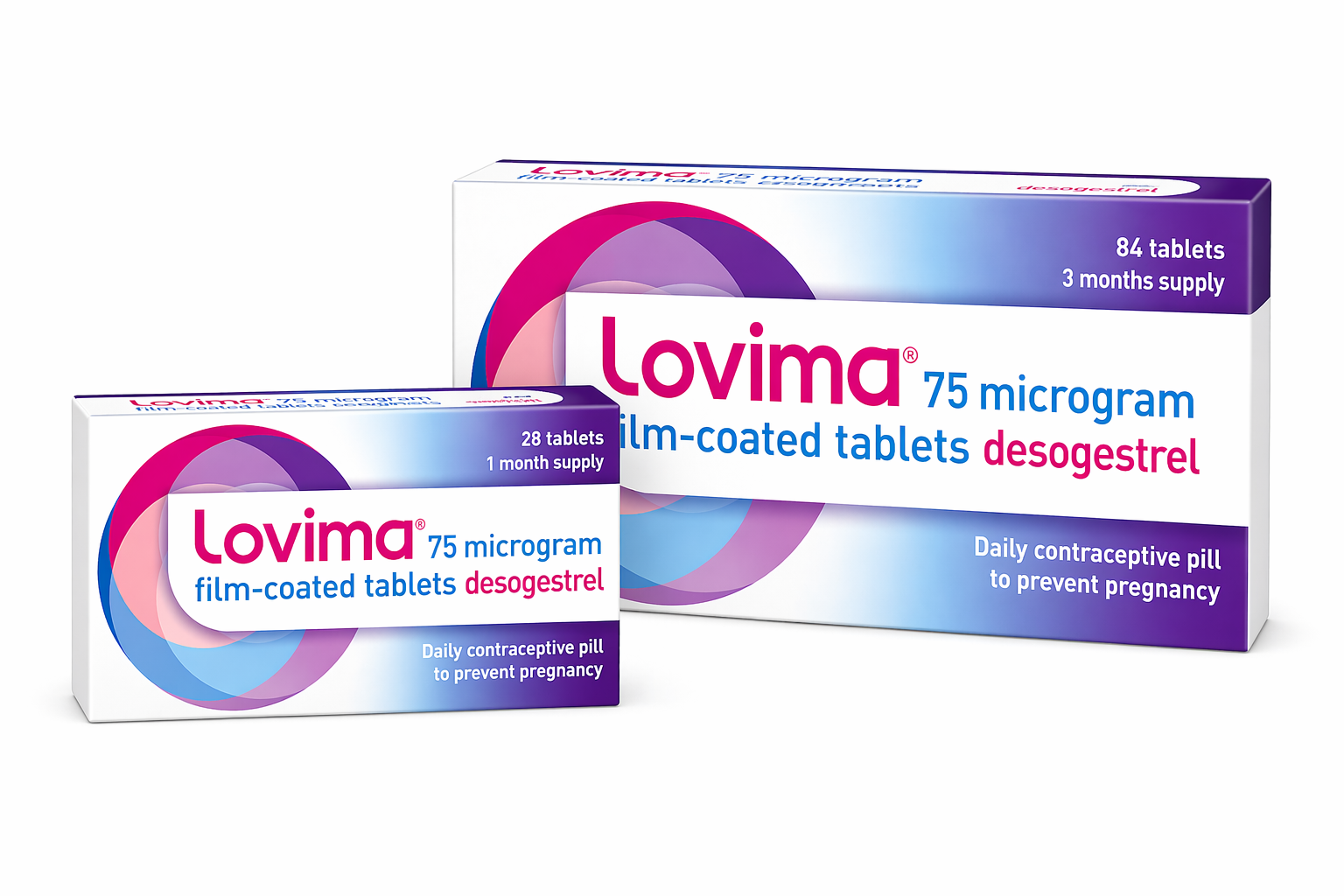

Lovima (Desogestrel) 75mcg Tablets
Price range: £11.99 through £18.99
Lovima is a daily progestogen-only contraceptive pill used to help prevent pregnancy following a clinical assessment.
It contains the active ingredient desogestrel, which works mainly by stopping the release of an egg from the ovaries (ovulation) and by thickening cervical mucus, making it harder for sperm to reach the womb. Taken at the same time every day, it provides continuous protection against pregnancy.
Lovima is not suitable for emergency contraception and does not protect against sexually transmitted infections.
Please Note: You are also required to complete a form at checkout. In addition, a video consultation with our pharmacist may be required.
Payment does not guarantee approval or supply
All prescription medication (Online Clinic) requests are subject to an independent clinical assessment. The final decision, including the medication and dose prescribed, rests with the prescriber. If your request is declined and no medication is supplied, your payment will be refunded in full in accordance with our refund policy.
Categories: Age verification, Contraception, Contraception, Female Health, Health & Wellbeing, Online Clinic, Online Shop, Sexual Wellbeing
Tags: OTC Review
What is Lovima used for?
Lovima is a daily hormonal contraceptive used to help prevent pregnancy in women and adolescents of childbearing age. It is taken every day to provide ongoing protection against pregnancy.
There are 2 main types of hormonal contraceptive:
• The combined pill (COC), which contains an oestrogen and a progestogen
• The progestogen-only pill (POP or mini-pill), which does not contain oestrogen
Lovima is a progestogen-only pill (POP). It contains a small amount of the synthetic hormone desogestrel, which is a type of progestogen.
Situations where Lovima may be used include:
- When a reliable daily contraceptive method is needed
- When oestrogen-containing contraceptives are not suitable or not tolerated
- During breast-feeding, when other contraceptives may not be appropriate
Unlike many other progestogen-only pills, Lovima works mainly by stopping the ovaries from releasing an egg (ovulation), as well as increasing cervical mucus to help prevent sperm reaching the womb.
Some women may experience irregular vaginal bleeding while taking Lovima. Others may have no bleeding at all.
Lovima does not protect against HIV infection (AIDS) or other sexually transmitted infections. Only condoms can help protect against STIs.
This product does not work as emergency contraception. When taken every day, it helps protect against pregnancy in the future.
How Lovima works
Lovima contains the active ingredient desogestrel. Desogestrel works by preventing pregnancy at different stages of the reproductive cycle.
It is thought to work by:
- Stopping the ovaries from releasing an egg (ovulation), which is its main method of action
- Thickening the cervical mucus, making it more difficult for sperm to enter the womb and reach an egg
- Thinning the lining of the womb (endometrium), making it less suitable for implantation
For Lovima to work effectively, it must be taken at the same time every day. Missing pills or taking them late can reduce its effectiveness and increase the risk of pregnancy.
| Quantity | 28, 84 |
|---|
Always use this medicine exactly as your doctor or pharmacist has told you. Check with your doctor or pharmacist if you are not sure how to use this medicine.
The recommended dose:
Take one tablet at the same time every day, without a break between packs. Swallow the tablet whole.
Choose a convenient time of day. It is best to link this to something you already do at the same time every day. For example, when you wake up, or when you brush your teeth.
Never skip your daily tablet. Take it every day, even when you bleed or have spotting.
The Lovima pack contains 28 tablets. The days of the week are printed on the pack, and arrows show the order to take the tablets. Every time you start a new pack of Lovima, take a tablet labelled with the correct day. For example, if you start on a Wednesday, you must take a tablet marked with Wed. Do not start with just any tablet.
How you first start taking Lovima will depend on whether you have previously used other contraception or if you have recently been pregnant. You may also need to use additional contraception for the first 7 days. Read the following information carefully to see which applies to you.
If you are starting or resuming Lovima following emergency contraception
Ask your pharmacist for advice on how to start taking or resume taking Lovima following emergency contraception. If you have taken emergency contraception, it is advisable to wait until day 1 of your next menstrual cycle before taking Lovima.
- Emergency contraception containing levonorgestrel can be used with Lovima. If you have used emergency contraception containing levonorgestrel during your cycle, you can start or continue taking Lovima the same day. You need to use additional barrier contraception (condom) every time you have sex for the next 7 days
- Using Lovima and emergency contraception containing ulipristal acetate together can alter the effect of both medicines, resulting in reduced contraceptive effect and increased risk of pregnancy. If you have used emergency contraception containing ulipristal acetate duringyour cycle, you must wait 5 days after taking ulipristal acetate before taking Lovima. You need to use additional barrier contraception (condom) for 5 days after taking ulipristal acetate while you wait to start or resume taking Lovima and then for the first 7 days after starting Lovima. (i.e. for a total of 12 days).
If you are not using hormonal contraception at present or have not used it in the past month
- Wait for your period to begin and start taking Lovima on the first day of your period. You do not need additional contraception
- You can also start on day 2-5 of your period. You need to use additional barrier contraception (condom) for 7 days.
If you are changing from a combined pill (COC)
- Start taking Lovima on the day after the last active tablet from your present Pill pack. Some COC packs have inactive pills so if you are not sure what is the last active tablet, check with the pharmacist. You do not need additional contraception
- If there is a break between when you took your last COC pill and when you start taking Lovima (i.e. you do not start taking Lovima the day immediately after taking the last active tablet). You need to use additional barrier contraception (condom) for 7 days.
If you are changing from a vaginal ring or transdermal patch
Start taking Lovima on the day your vaginal ring or patch is removed. You do not need additional contraception
If there is a break between removal of your ring or patch before you start taking Lovima (i.e. you do not take it on the same day). You need to use additional (barrier) contraception (condom) for 7 days.
If you are changing from another progestogen-only pill (mini-pill) including another desogestrel mini-pill which your doctor may have prescribed for you
- Start taking Lovima without a break. You do not need additional contraception. If you are changing from an injection or implant or hormonal IUS
- Start taking Lovima when your next injection is due or on the day your implant or IUS is removed. You do not need additional contraception.
If you have recently given birth and your period has not started again
- You can start Lovima before your period starts
- If you start taking Lovima more than 21 days after giving birth, you need to use additional contraception (condom) for 7 days. If you have had sex check that you are not pregnant before taking Lovima
- If your period has started again, refer to section “If you are not using hormonal contraception at present or have not used it in the past month”.
If you have recently had a miscarriage or abortion
- Start taking Lovima immediately or within 5 days after a miscarriage or abortion. You do not need additional contraception.
If you forget to take Lovima (missed pill)
When were you due to take the missed pill?
Less than 12 hours ago
- Take the missed tablet as soon as you remember and take the next tablet at the usualtime.
- Lovima will still protect you from pregnancy.
More than 12 hours ago
- If you are more than 12 hours late in taking any tablet, you may not be completely protected against pregnancy. The more consecutive tablets you have missed, the higher the risk that you might fall pregnant
- Take a tablet as soon as you remember and take the next one at the usual time. This may mean taking two in one day. This is not harmful. If you have forgotten more than one tablet, you don’t need to take the earlier missed ones. Continue to take your tablets as usual but you must also use additional barrier contraception (condom) for the next 7 days
- If you are more than 12 hours late taking your tablet and have sex consult your pharmacist for advice
- Missing tablets at any time in the cycle can reduce the efficacy of Lovima and risk pregnancy but if you have missed one or more tablets in the first week of taking Lovima and had sex in the week before missing the tablets, the risk that you may get pregnant is higher. Ask your pharmacist for advice and if you need to use emergency contraception.
If you vomit or have severe diarrhoea
If you vomit within 3 – 4 hours of taking Lovima, then the tablet should be considered ‘missed’ and the advice under above should be followed.
If you have severe or persistent vomiting or diarrhoea, Lovima may not have been completely absorbed and the contraceptive effect may be reduced. You should use an additional method of contraception (for example, condoms) for the duration of your illness and for the first 7 days of normal tablet-taking.
If you are not sure what to do talk to your pharmacist.
If you take more Lovima than you should
There have been no reports of serious harmful effects from taking too many Lovima tablets at one time. Symptoms that may occur are nausea, vomiting and in young girls, slight vaginal bleeding. For more information, ask your pharmacist for advice.
If you stop taking Lovima
You can stop taking Lovima whenever you want. From the day you stop, you are no longer protected against pregnancy.
Like all medicines, this medicine can cause side effects, although not everybody gets them. Some of the side effects are temporary with continued treatment or disappeared when treatment is stopped.
Side Effects
Common
- Mood changes
- Depressed mood
- Psychiatric disorders
- Decreased sexual drive (libido)
- Headache
- Nausea
- Acne
- Breast pain
- Irregular or no periods
- Weight increase
Irregular bleeding
Vaginal bleeding may occur at irregular intervals while using this medicine. This may be just slight staining which may not even require a pad, or heavier bleeding, which looks rather like a scanty period. You may need to use tampons or sanitary towels. You may also not have any bleeding at all. After a few months of treatment bleeding tends to become less frequent or stop altogether.
Irregular bleeding is not a sign that Lovima is not working. In general, you do not need to take any action; just continue to take Lovima. If bleeding is frequent, heavy or prolonged, or if you are worried by any changes in bleeding, you should talk to your doctor.
Uncommon
- Infection of the vagina
- Difficulties in wearing contact lenses
- Vomiting
- Hair loss
- Painful periods
- Ovarian cyst
- Tiredness
Rare
- Skin conditions such as rash, hives, erythema nodosum (painful rounded blue-red skin lumps usually on the shin and ankles, or sometimes thighs or forearms)
- Breast secretion or leakage may occur.
Serious Side Effects
You should seek medical advice immediately if you experience symptoms of angioedema (rapid swelling of area under skin or mucous membranes usually caused by an allergic reaction). Symptoms of angioedema include swollen face, tongue or throat, difficulty in swallowing, or hives and difficulty in breathing.
Thrombosis
See your doctor immediately if you notice possible signs of a thrombosis. Signs of a thrombosis include e.g. severe pain or swelling in either of your legs, unexplained pains in the chest, breathlessness, an unusual cough, especially if you cough up blood.
Ectopic pregnancy
Although desogestrel consistently inhibits ovulation and is an effective contraceptive, pregnancies and in some cases ectopic pregnancies (pregnancies where the fertilised egg attaches itself outside the womb) have been reported.
Contact your doctor immediately if you have a sudden or severe pain in the lower abdomen or stomach area with or without vaginal bleeding, even if you don’t think you are pregnant.
If you get any side effects, talk to your doctor or pharmacist. This includes any possible side effects not listed in this leaflet. You can also report side effects directly via the Yellow Card Scheme at www.mhra.gov.uk/yellowcard or search for MHRA Yellow Card in the Google Play or Apple App Store. By reporting side effects you can help provide more information on the safety of this medicine.
Warning & Precautions
Please refer to the ‘Information and Advice’ tab to access the Patient Information Leaflet for more detailed guidance.
Do not take Lovima if you
- are pregnant or think you may be pregnant. If you are unsure talk to your pharmacist
- have a thrombosis. Thrombosis is the formation of a blood clot, which may block a blood vessel. A thrombosis sometimes occurs in the deep veins of the legs (deep venous thrombosis). If this clot breaks away from the veins where it is formed, it may reach and block the arteries of the lungs, causing a so-called “pulmonary embolism”. Signs of a thrombosis include severe pain or swelling in either of your legs, unexplained pains in the chest, breathlessness, an unusual cough, especially if you cough up blood
- have or have had jaundice (yellowing of the skin) or severe liver disease and you have been told that your liver is still not working normally
- have or if you are suspected of having cancer that grows under the influence of sex- steroids, such as certain types of breast, uterine or ovarian cancer
- have any unexplained vaginal bleeding
- are allergic to desogestrel, peanut, soya or any of the other ingredients of this medicine
If any of these conditions apply to you, you should consult your doctor before taking Lovima.
Talk to your pharmacist, doctor or family planning nurse before using Lovima if you:
- have ever had breast cancer
- have liver cancer or other liver problems
- have ever had a thrombosis
- have diabetes
- suffer from epilepsy
- suffer from tuberculosis
- have high blood pressure
- have or have had chloasma (yellowish-brown pigmentation patches on the skin, particularly of the face); if so, avoid too much exposure to the sun or ultraviolet radiation.
These are important conditions that your doctor may need to monitor carefully.
Breast cancer
It is important to regularly check your breasts, and you should contact your doctor as soon as possible if you feel any lump in your breasts.
Breast cancer has been found slightly more often in women who take the combined oestrogen/progestogen pill (COC) than in women of the same age who do not take the COC pill. If women stop taking the COC pill, this reduces the risk, so that 10 years after stopping the COC pill, the risk is the same as for women who have never taken the COC pill. Breast cancer is rare under 40 years of age, but the risk increases as the woman gets older. Therefore, the extra number of breast cancers diagnosed is higher if a woman continues to take the COC pill when she is older. How long she takes the COC pill is less important.
Thrombosis
Thrombosis is the formation of a blood clot, which may block a blood vessel. A thrombosis sometimes occurs in the deep veins of the legs (deep venous thrombosis). If this clot breaks away from the veins where it is formed, it may reach and block the arteries of the lungs, causing a so-called “pulmonary embolism”. A pulmonary embolism can cause chest pain, breathlessness, collapse or even death.
Deep venous thrombosis is a rare occurrence. It can develop whether or not you are taking the Pill. It can also happen if you become pregnant.
The risk is higher in users of the combined oestrogen/progesterone pill (COC) than in non- users. However, the risk with progestogen-only pills, like Lovima has not been established.
Ectopic pregnancy
Although desogestrel consistently inhibits ovulation and is an effective contraceptive, pregnancies and in some cases ectopic pregnancies (pregnancies where the fertilised egg attaches itself outside the womb) have been reported. Contact your doctor immediately if you have a sudden or severe pain in the lower abdomen or stomach area with or without vaginal bleeding, even if you don’t think you are pregnant.
Psychiatric disorders
Some women using hormonal contraceptives including desogestrel have reported depression or depressed mood. Depression can be serious and may sometimes lead to suicidal thoughts. If you experience mood changes and depressive symptoms, contact your doctor for further medical advice as soon as possible.
High blood pressure
If you develop high blood pressure while taking Lovima seek medical advice as soon as possible. You may need to stop taking Lovima.
Diabetes
The active ingredient (desogestrel) in Lovima may have an effect on the control of diabetes. If you are diabetic consult your doctor before starting treatment with Lovima.
Bone strength
Treatment with desogestrel leads to decreased oestrogen levels in the blood to levels similar to those which occur naturally during the menstrual cycle. There is no evidence to show that this reduction has any effect on bone strength.
Age Restrictions
For childbearing age women, 18 years and above
Other Medicines and Conditions
Tell your pharmacist, doctor or family planning nurse if you are taking, have recently taken or
might take any other medicines or herbal products. Also tell any other doctor or dentist who
prescribes another medicine (or your pharmacist) that you take Lovima.
Some medicines can make Lovima less effective at preventing pregnancy.
If you are using one of these medicines or herbal products for short-term treatment, you can
continue using Lovima, but you must also use additional contraception (for example,
condoms) every time you have sex during treatment and for 28 days after stopping the last dose
of the other medicine or herbal product.
If you are using any of these medicines or herbal products either chronically or for long-term
treatment you should consult your doctor for advice, as an alternative method of contraception
may be more appropriate for you.
Medicines classed as enzyme-inducers which can make Lovima less effective include those
used for the treatment of:
• epilepsy (e.g. primidone, phenytoin, carbamazepine, oxcarbazepine, topiramate, felbamate,
and phenobarbital)
• tuberculosis (e.g. rifampicin and rifabutin)
• depressive moods (the herbal remedy St John’s wort).
Medicinal charcoal used to treat drug poisoning or overdose may reduce the absorption of
Lovima and can make it less effective at preventing pregnancy.
Some other medicines may also reduce the efficacy of Lovima or have variable effects such as
medicines for the treatment of HIV infections (e.g. ritonavir, nelfinavir and nevirapine), or
Hepatitis C virus infections (e.g. boceprevir and telaprevir).
Medicines classed as enzyme-inhibitors which can increase hormone levels with Lovima
include those used for the treatment of:
• certain bacterial infections (e.g. clarithromycin, erythromycin)
• fungal infections (e.g. ketoconazole, itraconazole, fluconazole and griseofulvin)
• high blood pressure (hypertension), angina or certain heart rhythm disorders (e.g.
diltiazem).
Lovima may also interfere with how certain medicines work, causing either an increase in effect
(e.g. medicines containing cyclosporine used to prevent organ rejection following transplant) or
a decrease in effect.
Taking emergency contraception containing ulipristal acetate
Using Lovima and emergency contraception containing ulipristal acetate together can alter
the effect of both these medicines, resulting in reduced contraceptive effect and increased risk
of pregnancy.
If you have used emergency contraception containing ulipristal acetate during your cycle, you
must wait 5 days after taking ulipristal acetate before taking Lovima. You must also use
additional contraception (for example, condoms) every time you have sex during the 5 days
while you wait to start or resume taking Lovima and for the first 7 days of taking Lovima (ie.
for a total of 12 days).
Pregnancy and Breastfeeding
Pregnancy
Do not use Lovima if you are pregnant or think you may be pregnant. Take a pregnancy test or
talk to your pharmacist, doctor or family planning nurse if your period is late after missing any
tablets in the last month, or if you think you may be pregnant. Stop taking Lovima and see
your doctor if you become pregnant.
Breastfeeding
Lovima may be used while you are breastfeeding. Desogestrel (the active substance in Lovima)
does not appear to influence the production or the quality of breast milk. However, there have
been infrequent reports of a decrease in breast milk production while using desogestrel. A small
amount of desogestrel passes over into the milk.
If you are breastfeeding, let your pharmacist know.
Patient Information Leaflet
https://www.medicines.org.uk/emc/files/pil.12736.pdf
Ingredients
- Active Ingredients: Desogestrel
- Other Ingredients: lactose monohydrate, maize starch, povidone (E1201), d-α-tocopherol (E307), containing soybean oil), colloidal hydrated silica (E551), colloidal anhydrous silica (E551), stearic acid (E570), hypromellose (E464), polyethylene glycol, titanium dioxide (E171), soybean oil and lactose
Product Information
- Brand Name: Lovima
- Route of Administration: Oral
- Legal Classification: P-med
- Strength: 75mcg
- Dosage From: Tablet
Storage
- Keep this medicine out of the sight and reach of children.
- Do not use after the expiry date which is stated on the package after EXP. The expiry date refers to the last day of the month.
- Store in the original packaging in order to protect from light.
- Do not throw away any medicines via wastewater or household waste. Ask your pharmacist how to throw away medicines you no longer use. These measures will help to protect the environment.
Advice & Helpful Links
https://www.nhs.uk/contraception/
https://www.letstalkaboutit.nhs.uk/contraception
Regular contraception
There are many different types of contraception available, and you should be able to find the right method for you.
You can speak to your prescriber, doctor or family planning nurse for advice.
You may also like...