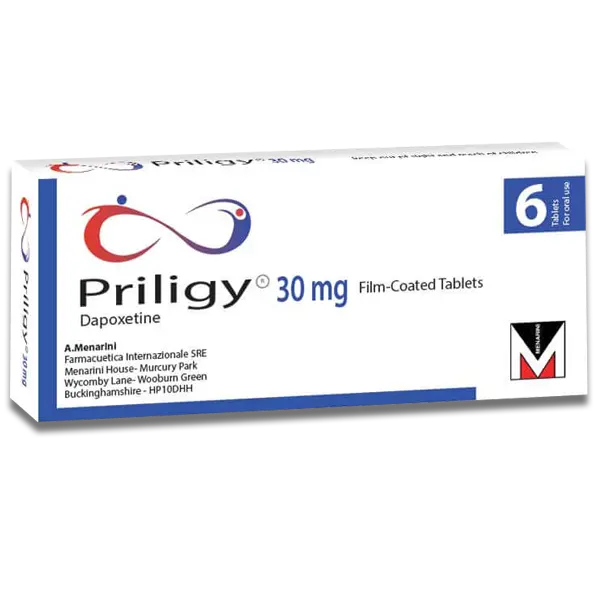
Priligy
Price range: £26.99 through £41.99
Priligy is an effective treatment for premature ejaculation (PE) in adult men aged 18 to 64 years, following a clinical assessment.
Priligy works by increasing serotonin activity in the nervous system, helping to delay ejaculation and improve control during sexual activity. It is taken 1 to 3 hours before sex and should only be used when needed. Priligy will only work for men with premature ejaculation and is not intended to treat erectile dysfunction or increase sexual desire.
Please Note: You are also required to complete a form at checkout. In addition, a video consultation with our pharmacist may be required.
Payment does not guarantee approval or supply
All prescription medication (Online Clinic) requests are subject to an independent clinical assessment. The final decision, including the medication and dose prescribed, rests with the prescriber. If your request is declined and no medication is supplied, your payment will be refunded in full in accordance with our refund policy.
Categories: Male Health, Online Clinic, Premature Ejaculation
Tags: ID Required, Private Rx
What is Priligy used for?
Priligy is used to treat premature ejaculation (PE) in adult men aged 18 to 64 years.
Premature ejaculation is a condition where a man ejaculates sooner than he or his partner would like during sexual activity, often with minimal sexual stimulation. Priligy can help men improve control over ejaculation and increase the time it takes to ejaculate.
Priligy contains the active ingredient dapoxetine and belongs to a group of medicines known as selective serotonin reuptake inhibitors (SSRIs). It is specifically developed for the treatment of premature ejaculation.
How Priligy works
Priligy works by increasing the activity of serotonin in the nervous system.
Serotonin is a natural chemical that plays a role in controlling ejaculation. By increasing serotonin’s action, dapoxetine helps delay the ejaculation reflex, allowing men to have better control over when ejaculation occurs during sexual activity.
This can increase the time to ejaculation, improve control over ejaculation, and help reduce the frustration, anxiety, or distress associated with premature ejaculation.
It is important to note that Priligy is intended only for men diagnosed with premature ejaculation. It does not treat erectile dysfunction, increase sexual desire, or improve sexual performance in men who do not have premature ejaculation.
| Quantity | 3 tablets, 6 tablets |
|---|
Always use this medicine exactly as your doctor or pharmacist has told you. Check with your doctor or pharmacist if you are not sure how to use this medicine.
The recommended dose for adults:
The recommended dose is 30mg.Swallow the tablets whole to avoid a bitter taste, with at least one full glass of water. This may help lower your chance of fainting. This can be taken with or without food.
Only take the medicine 1 to 3 hours before sexual activity is anticipated. Do not take this medicine more than once every 24 hours or every day.
Priligy is not intended for daily use, only for when sexual activity is anticipated.
Depending on effectiveness and tolerability, your prescriber may suggest adjusting the dose if 30mg is insufficient.
If you take more Priligy than you should
Tell your doctor or pharmacist if you have taken more tablets than you should. You may feel sick or be sick.
If you stop taking Priligy
Talk to your doctor before you stop taking this medicine. You may have problems sleeping and feel dizzy after you stop taking this medicine, even if you have not taken it every day.
Like all medicines, this medicine can cause side effects, although not everybody gets them. Some of the side effects are temporary with continued treatment or disappeared when treatment is stopped.
Side Effects
Very common
- Feeling dizzy
- Headache
- Feeling sick
Common
- Feeling irritable, anxious, agitated or restless
- Feeling numb or having ‘pins and needles’
- Difficulty getting or keeping an erection
- Sweating more than normal or flushing
- Diarrhoea, constipation or having wind
- Stomach pain, bloating or being sick
- Problems sleeping or strange dreams
- Feeling tired or sleepy, yawning
- Blocked nose (nasal congestion)
- A rise in blood pressure
- Difficulty concentrating
- Shaking or trembling
- Lower interest in sex
- Ringing in the ears
- Blurred vision
- Indigestion
- Dry mouth
Uncommon
- Fainting or feeling dizzy upon standing (see advice above)
- Change in mood, feeling overly excited or feelings of paranoia
- Feeling confused, disoriented or unable to think clearly
- Slow or irregular heartbeat or increase in heart rate
- Loss of sex drive, problems reaching orgasm
- Feeling weak, sedated, lethargic or fatigued
- Feeling depressed, nervous or indifferent
- Feeling hot, jittery, abnormal or drunk
- Vision problems, eye pain or dilated pupils
- Low or high blood pressure
- Feeling itchy or cold sweat
- Spinning sensation
- Abnormal taste
- Teeth grinding
Rare
- Feeling dizzy following exertion
- Sudden onset of sleep
- Urgency of bowel action
If you get any side effects, talk to your doctor or pharmacist. This includes any possible side effects not listed in this leaflet. You can also report side effects directly via the Yellow Card Scheme at www.mhra.gov.uk/yellowcard or search for MHRA Yellow Card in the Google Play or Apple App Store. By reporting side effects you can help provide more information on the safety of this medicine.
Warning & Precautions
Do not take Priligy if:
- you are allergic to dapoxetine or any of the other ingredients of this medicine
- you have heart problems, such as heart failure or problems with the heart rhythm
- you have a history of fainting
- you have ever had mania (symptoms include feeling over
- excited, irritable or not being able to think clearly) or severe depression
- you have moderate or severe liver problems.
- you are taking:
- Medicines for depression called ‘monoamine oxidase inhibitors’ (MAOIs)
- Thioridazine used for schizophrenia
- Other medicines for depression
- Lithium
- Linezolid
- Tryptophan
- St John’s wort
- Tramadol
- Medicines used to treat migraines.
Do not take Priligy at the same time as any of the medicines listed above. If you have taken any of these medicines, you will need to wait 14 days after you stop taking it before you can start taking Priligy. Once you have stopped taking Priligy, you will need to wait 7 days before taking any of the medicines listed above.
If you are not sure about what to do, talk to your doctor or pharmacist before taking this medicine.
- Certain medicines for fungal infection, including ketoconazole and itraconazole
- Certain medicines for HIV, including ritonavir, saquinavir, nelfinavir and atazanavir
- Certain antibiotics for treating infection, including telithromycin
- Nefazodone
Do not take this medicine if any of the above apply to you. If you are not sure, talk to your doctor or pharmacist before taking this medicine.
Talk to your doctor, pharmacist or nurse before taking Priligy if:
- You have not been diagnosed with premature ejaculation
- You also have another sexual problem, such as erectile dysfunction
- You have a history of dizziness from low blood pressure
- You use recreational drugs such as ecstasy, LSD, narcotics or benzodiazepines
- You drink alcohol
- You have ever had a mental health problem such as depression, mania (symptoms include feeling over, excited, irritable or not being able to think clearly), bipolar disorder (symptoms include serious mood swings between mania and depression) or schizophrenia (a psychiatric disease)
- You have epilepsy
- You have a history of bleeding or blood clotting problems
- You have kidney problems
- You have, or are at risk of, high pressure in the eye (glaucoma)
If any of the above apply to you (or you are not sure), talk to your doctor or pharmacist before taking this medicine. Before you start taking this medicine, your doctor should perform a test to make sure that your blood pressure doesn’t drop too much when you stand up from lying down.
Age Restrictions
Suitable for men aged 18 to 64 years
Other Medicines and Conditions
Tell your doctor or pharmacist if you are taking, have recently taken, or might take any other medicines. This includes medicines you get without a prescription, such as herbal medicines. This is because Priligy can affect the way some other medicines work. Also some other medicines can affect the way Priligy works. Therefore, use of other medicines may affect the maximum dose of Priligy you’re allowed to take.
Do not take Priligy at the same time as any of the following medicines:
- Medicines for depression called ‘monoamine oxidase inhibitors’ (MAOIs)
- Thioridazine used for schizophrenia
- Other medicines for depression
- Lithium
- Linezolid
- Tryptophan
- St John’s wort
- Tramadol
- Medicines used to treat migraines
Do not take Priligy at the same time as any of the medicines listed above. If you have taken any of these medicines, you will need to wait 14 days after you stop taking it before you can start taking Priligy. Once you have stopped taking Priligy, you will need to wait 7 days before taking any of the medicines listed above. If you are not sure about what to do, talk to your doctor or pharmacist before taking this medicine.
- Certain medicines for fungal infection, including ketoconazole and itraconazole
- Certain medicines for HIV, including ritonavir, saquinavir, nelfinavir and atazanavir
- Certain antibiotics for treating infection, including telithromycin
- Nefazodone
Tell your doctor or pharmacist if you are taking any of the following medicines:
- Medicines for mental health problems other than depression
- Non-steroidal anti-inflammatory medicines such as ibuprofen or acetylsalicyclic acid
- Medicines to thin your blood, such as warfarin
- Certain medicines used to treat erectile dysfunction, such as sildenafil, tadalafil or vardenafil, as these medicines may lower your blood pressure, possibly upon standing
- Certain medicines used to treat high blood pressure and chest pain (angina) (such as verapamil and diltiazem), or enlarged prostate, as these medicines may also lower your blood pressure, possibly upon standing
- Certain other medicines for fungal infection, such as fluconazole
- Certain other medicines for HIV, such as amprenavir and fosamprenavir
- Certain other antibiotics for treating infection, such as erythromycin and clarithromycin
- Aprepitant
If you are not sure if any of the above apply to you, talk to your doctor or pharmacist before taking this medicine.
Priligy with food, drink and alcohol
- This medicine can be taken with or without food.
- You should take this medicine with at least one full glass of water.
- Avoid alcohol when taking this medicine.
- The effects of alcohol such as feeling dizzy, sleepy and having slow reactions, may be increased if taken with this medicine.
- Drinking alcohol while taking this medicine may increase your risk of injury from fainting or from other side effects.
Fainting and low blood pressure
This medicine can make you faint or make your blood pressure drop when you stand up. To help lower the chance of this happening:
- Take this medicine with at least one full glass of water
- Do not take this medicine if you are dehydrated (you do not have enough water in your body).
- This can happen if: You have not had anything to drink in the past 4 to 6 hours, You have been sweating for a long time, you have an illness where you have a high temperature, diarrhoea or being sick
- If you feel like you might faint (such as feeling sick, feeling dizzy, light headed, confused, sweaty or an abnormal heart beat), or feel light headed when you stand up, immediately lie down so your head is lower than the rest of your body or sit down with your head between your knees until you feel better. This will stop you from falling and hurting yourself if you do faint.
- Do not stand up quickly after you have been sitting or lying down for a long time.
- Do not drive or use any tools or machines if you feel faint when taking this medicine.
Driving and using machines
You may feel sleepy, dizzy, faint, have difficulty concentrating and blurred vision while taking this medicine. If you experience any of these or similar effects, you should avoid driving or operating hazardous machinery. The effects of alcohol may be increased if taken with this medicine and you may be more at risk of injury from fainting or from other side effects if you take this medicine with alcohol.
Pregnancy and Breastfeeding
This medicine is not suitable for use in pregnancy and breastfeeding.
Patient Information Leaflet
https://www.simplymedsonline.co.uk/storage/otherdocuments/priligy_pil.pdf
Ingredients
- Active Ingredients: Dapoxetine
- Other Ingredients: Tablet core: lactose monohydrate, microcrystalline cellulose, croscarmellose sodium, colloidal anhydrous silica, magnesium stearate Tablet coating: lactose monohydrate, hypromellose, titanium dioxide (E171), triacetin, Iron Oxide Black (E172), Iron Oxide Yellow (E172)
Product Information
- Brand Name: Priligy
- Route of Administration: Oral
- Legal Classification: Prescription Only Medication (POM)
- Strength: 30mg & 60mg
- Dosage From: Tablet
Storage
- Keep this medicine out of the sight and reach of children.
- Do not use this medicine after the expiry date which is stated on the carton and blister after ‘EXP’. The expiry date refers to the last day of that month.
- This medicinal product does not require any special storage conditions.
- Do not throw away any medicines via wastewater or household waste. Ask your pharmacist how to throw away medicines you no longer use. These measures will help protect the environment.
Advice & Helpful Links